Get Free Consultation!
We are ready to answer right now!
Whatsapp us for fast response!
I consent to the processing of personal data and agree with the user agreement and privacy policy

Figuring out the rules around driving on a foreign license in the UK can feel overwhelming. Whether you are coming over for a short holiday, studying at university, or relocating long-term, the DVLA sets very specific requirements depending on where your licence was issued and your residency status in Great Britain.
At Fast UK Licensed, we make it simple for international drivers to understand British road laws and get on the road with confidence.
This complete guide covers everything you need to know about driving in GB on a foreign licence, including time limits, International Driving Permits (IDPs), car insurance requirements, and how to swap your licence.
Licensing rules, exchange deadlines, and driving permissions can get confusing fast. Select your details in our quick checker below to see exactly how your driving in the UK with an international licence works and what you need to do next.

If you are visiting England, Scotland, or Wales as a tourist or short-term visitor, you can legally drive using a foreign driving licence in the UK for up to 12 months from the date you last arrived. This covers any standard car or motorcycle listed on your licence, up to 3,500 kg with up to 8 passenger seats.
Your foreign licence must stay valid for your entire stay, and you can only drive the type of transmission (manual or automatic) you’re qualified for back home. You’ll also need valid third-party insurance before getting behind the wheel.
Keep in mind that car rental companies set their own rules, typically requiring you to be at least 21 (and often 25) with a full, clean licence held for at least a year.
Because Northern Ireland is part of the UK, full Northern Ireland licence holders moving to Great Britain, including students, can drive on their licence until it expires without needing to exchange it.
Short term visitors holding a European licence in the UK can legally drive any vehicle category shown on their licence for up to 12 months. This covers large vehicles like lorries, as long as your permit allows it and you are at least 21 years old. Drivers must carry valid proof of insurance, such as an official Green Card or insurer letter.
Note: Green Cards from Russia or Belarus are no longer valid in Great Britain.
Drivers holding a valid licence from Gibraltar, Jersey, Guernsey, or the Isle of Man can drive small vehicles in Great Britain for up to 12 months after arriving.
If you have a full lorry or bus licence, you can also operate large commercial vehicles registered in Great Britain for up to a year. For permits from Jersey, Guernsey, or the Isle of Man, you are allowed to drive foreign registered buses or lorries as well, as long as you personally drove the vehicle into Great Britain.
If you hold a full, valid licence from a country outside the EU or Crown Dependencies, you can drive small vehicles listed on your permit for up to 12 months from the date you last arrived in Great Britain.
Commercial rules are much stricter for heavy vehicles: bus and lorry licence holders can only drive foreign registered vehicles that they personally drove into the country.
Many people are confused about whether they need an international drivers license in the UK. The Driver and Vehicle Licensing Agency (DVLA) recognises official International Driving Permits (IDP) issued under the 1926, 1949, or 1968 conventions, but not unofficial or private “international driver’s licence” cards.
You do not need an IDP if your foreign licence is in English or issued by an EU or EEA country.
However, if your original licence is in a non Latin script like Arabic, Bengali, Japanese, or Cyrillic, or any language other than English, you must carry an official IDP alongside your national permit whenever you drive.
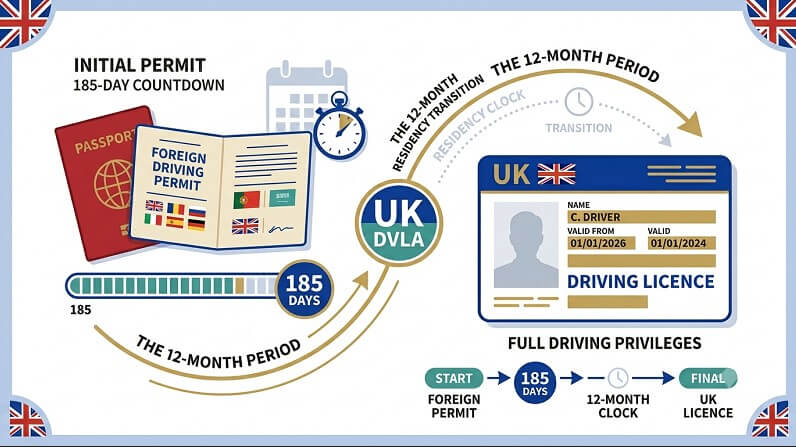
Once you live in Great Britain for 185 days or more in a calendar year, the DVLA considers you a resident. Your path to remaining legally on the road depends entirely on where your original licence was issued and which specific vehicle categories you hold.
Rules vary significantly between standard car or motorcycle permits and commercial licences for lorries, minibuses, or buses.
With a valid EU driving licence in the UK, you are allowed to drive using your home licence until you turn 70. (If you moved here when you were 67 or older, you get a solid 3-year grace period from the date you became a resident.)
You don’t have to exchange your licence for a British one immediately, but doing so simplifies things and requires no driving test. However, if you plan to keep driving past the 3-year mark, swapping your licence becomes compulsory.
Note: If your EU licence was obtained by exchanging a non-EU one, it is only valid in the UK for up to 12 months.
If you want to know whether you are allowed to drive in the UK, you should first check if your country is on the designated list.
The ‘designated countries or territories’ are: Andorra, Australia, Barbados, British Virgin Islands, Canada, Cayman Islands, Falkland Islands, Faroe Islands, Gibraltar, Hong Kong, Japan, Monaco, New Zealand, Republic of Korea, Republic of Moldova, Republic of North Macedonia, Singapore, South Africa, Switzerland, Taiwan, Ukraine, United Arab Emirates and Zimbabwe.
You can drive any type of small vehicle (like a car or motorcycle) in the UK for up to 12 months from the date you became resident.
To keep driving after your first year, you must exchange your licence for a British one. You can make this swap anytime within 5 years of moving to the UK without having to retake a driving test.
Did you miss the 5-year exchange deadline?
If yes, you will have to apply for a brand-new UK driving licence from scratch, including passing both tests.
Similar to designated countries, holders of licences from non-designated countries are permitted to drive in the UK for up to 12 months.
However, a licence exchange scheme is not available from these countries.
To continue driving, you must obtain a full GB licence by applying for a provisional licence, passing the theory exam, and successfully completing the practical test.
For EU or Swiss heavy vehicle licences (categories C1, C, D1, and D), your driving entitlements depend on your age when you moved to the UK:
Note: For vehicles over 3.5 tonnes (Categories C1 and C) or passenger vehicles with 9+ seats (Categories D1 and D), you are legally required to register your licence details with the DVLA within 12 months of moving to the UK.
You can drive in Great Britain on your original licence for up to 12 months from the date you became a resident.
After 12 months, you must exchange your licence for a GB driving licence. You have a 5-year window from your residency start date to make this swap without taking any tests.
If you don’t exchange your licence within that 5-year period, you will lose your driving entitlement and will need to apply as a learner, passing the theory and practical tests to get a GB licence.
Driving licence holders from other countries are not permitted to drive heavy lorries, minibuses, or buses in the UK. To drive these vehicles, you will need to go through the full UK HGV driving licence process.
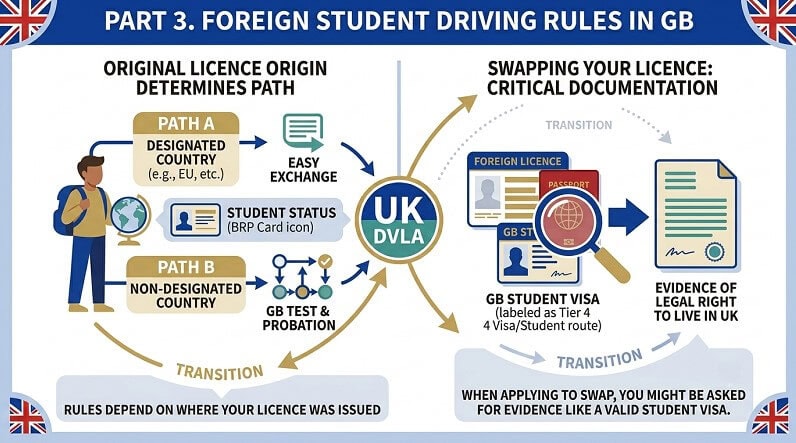
If you move to Great Britain as a student, the rules for driving depend on where your licence was issued.
When applying to swap your licence, you might be asked for evidence of your legal right to live in the UK, such as a valid student visa.
You can continue driving on your original licence for as long as it remains valid, or until you turn 70. There is no requirement to exchange your licence or take a UK driving test.
You can drive on your foreign licence for up to 12 months from the date you become a UK resident. If your licence was issued in a designated country, you can exchange it for a British licence within 5 years of residency without taking a driving test.
You are allowed to drive small vehicles on your valid foreign licence for up to 12 months from the date you arrive in the UK. Once that 12 month period ends, you must apply for a UK provisional licence and pass the theory and practical driving tests to stay on the road.
Keep in mind that you need to live in Great Britain for at least 185 days before applying, as official UK driving licences and test bookings are reserved strictly for legal residents.
While the standard GOV.UK interactive tool mainly covers regular cars, a different set of rules applies if your licence includes heavy goods vehicles (HGV / Category C or C1).
If you have a valid EU or EEA licence, you can drive HGVs in Great Britain until you turn 45, or for up to 5 years after moving here—whichever gives you more time.
Drivers holding HGV entitlements from non-EU/EEA nations (such as India, Pakistan, Nigeria, the United States, or designated exchange partners like Australia and Canada) cannot use their home licence to drive large commercial vehicles while residing in the UK.
To drive an HGV legally, you must go through the standard UK licensing process: secure a UK provisional entitlement and pass the full series of HGV theory, practical driving, and Driver CPC tests.
If you live in the UK and drive vehicles over 3.5 tonnes on a foreign licence, you must register your details with the DVLA within 12 months of moving here using Form D9.
To work as a commercial HGV driver in the UK, holding an active Driver CPC is mandatory. Additionally, student visa holders should note that term-time work is strictly capped at 20 hours a week.
Driving rules in Northern Ireland are managed separately by the DVA (Driver & Vehicle Agency). While general time limits and exchange rules are similar to Great Britain, application forms and local guidelines are handled by Northern Ireland authorities. For official rules in NI, visit NIDirect: Advice on foreign driving licences in Northern Ireland.
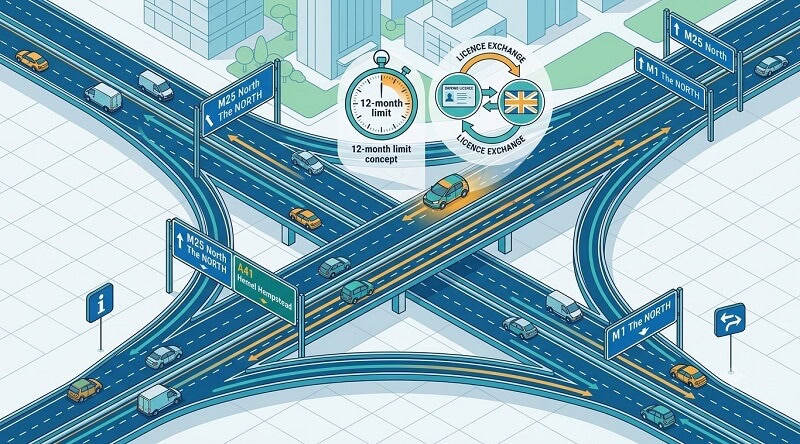
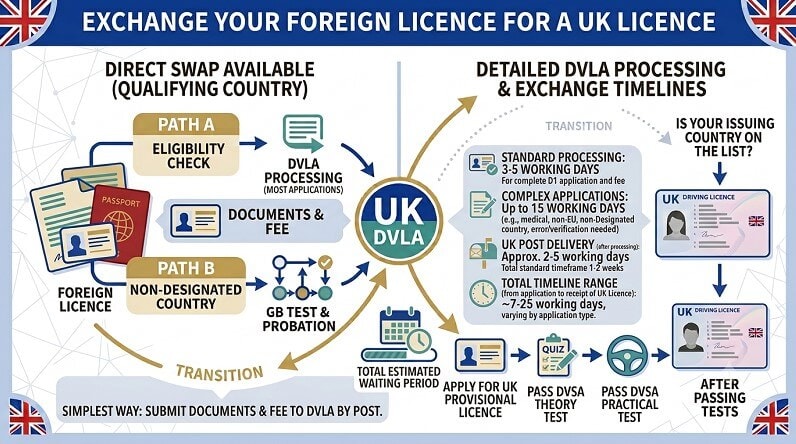
Exchanging a foreign licence is usually the simplest way to stay legally on the road in Great Britain. As long as your issuing country qualifies, the process involves submitting your documents and application fee to the DVLA by post.
To learn about eligibility criteria, required DVLA forms (such as the D1 pack), application fees, processing timelines, and step-by-step submission instructions, read our complete guide on how to exchange a foreign driving licence for a UK licence.
Note: If your issuing country does not qualify for a direct swap, you must apply for a UK provisional licence and prepare for the DVSA theory and practical driving tests.
Yes, you can drive in Great Britain for up to 12 months on a valid US driver’s licence. However, because the USA is not a designated exchange country for manual cars, you must pass the UK theory and practical tests after 12 months to continue driving.
During your first 12 months of residency, you can drive solo on your foreign licence while practicing. However, after 12 months, you must drive under learner conditions with ‘L’ plates and a qualified supervisor.
Yes, absolutely. Driving without valid insurance is illegal in the UK, regardless of the type of licence you hold or how long you are staying. You must have at least third party cover in place before taking any vehicle onto public roads. Driving uninsured risks a fixed penalty fine, points on your record, and immediate vehicle seizure.
Yes. You can drive small vehicles in the UK on a valid Indian licence for up to 12 months from the date you arrive. Because Indian licences are in English, you do not need an International Driving Permit (IDP). However, to keep driving past 1 year, you must pass the UK theory and practical tests.
Moving onto British roads involves far more than just learning DVLA rules. You also need to master UK road signs, get used to local driving etiquette, and pass the comprehensive DVLA theory and practical tests.
Fast UK Licensed provides all the core tools to help you gain your full licence without unnecessary stress. You can test your knowledge using our Car Theory Test Practice Tool, sharpen your skills with our Motorcycle Theory Practice, or study our specialized HGV & Heavy Vehicle Revision Guides.

Driving Instructor, Theory Test Specialist & Content Creator
Dorian West is a veteran driving instructor and educational content creator with thirty years of hands-on experience coaching students through the UK driving theory test and intensive driving courses. Having navigated the roads of London and now operating out of Luton, Dorian has dedicated his career to empowering learners with the knowledge, road safety awareness, and confidence needed for independent driving.
No account yet?
Create an Account