Get Free Consultation!
We are ready to answer right now! Sign up for a free consultation.
I consent to the processing of personal data and agree with the user agreement and privacy policy

Getting your head around UK road signs for learners is often one of the most frustrating parts of the entire driving process. It’s easy enough to spot a standard stop sign or check your speedometer against a standard speed limit, but the DVSA theory and practical tests love to throw in those lesser-known, easily confused symbols that catch people off guard.
The stats do not lie. Thousands of people fail their driving test every year simply because they misread standard road traffic signs UK examiners expect you to know inside out. Missing a hazard warning or messing up a basic order can instantly turn a perfectly good drive into a major fault or even a dangerous situation on the road.
At Fast UK Licensed, we want you to pass your test on the very first try. To clear up any confusion and get your revision on track, let’s look at 12 essential driving road signs UK drivers often trip over, along with exactly what the highway code uk road signs expect you to do when you see them.
Before we get into the specific signs that trip people up, you need to understand how all UK highway road signs are set up. The Highway Code uses a really simple system of shapes and colors to tell you what a sign means before you even get close enough to read it.
Misreading a road sign can instantly fail your driving test. But on your own, the stakes are much higher. Missing a mandatory order or a hazard warning can quickly lead to heavy fines, penalty points on your licence, or a serious accident. Staying alert does not just protect your license; it keeps people alive.
On that note, if you already have a messy driving record or are trying to get back behind the wheel after a disqualification, we can provide compliant penalty points removal help and guide you through the driving ban uplift process to get you back on the road safely.

The Design
A red warning triangle with two black arrows pointing left and right.
Why Learners Fail
It looks incredibly similar to the warning sign for two-way traffic ahead, which uses vertical arrows instead. Because they look so alike, a huge number of learners mistake it for an indication that their current road is simply turning into a two-way street.
The Exact Meaning & Practical Reaction
This sign is telling you that the one-way street you are driving down is about to end at a junction. When you reach the end, traffic on the next road will be moving both ways across you.
Because you have been cruising down a one-way street, it is easy to get a bit lazy with your observations. As soon as you spot this sign, you need to wake your eyes up and prepare to check both left and right thoroughly. Vehicles will be crossing your path directly ahead, so your normal cross-junction checks are absolutely vital here.
The Design
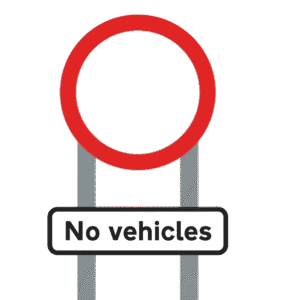
A plain red circle with a completely blank white middle.
Why Learners Fail
It looks so blank that a lot of learners assume it is a mistake, an unfinished sign, or just something that faded in the sun over time. Because there is no text or symbol inside the circle to tell you what to do, it is incredibly easy to overlook or ignore entirely.
The Exact Meaning & Practical Reaction
This is one of the strictest rules on British roads. It means the street ahead is completely closed to any kind of motorized vehicle. The only way you are allowed past it is if you are a cyclist who gets off and physically pushes your bike by hand.
If you see this sign during your driving test, do not turn down that road. If you do, it counts as breaking a mandatory order, which means an instant fail for your test.
The Design
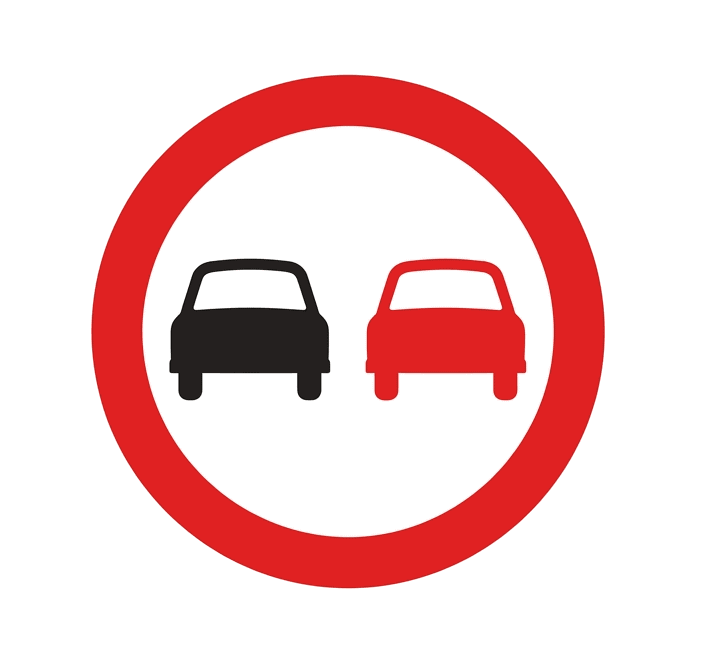
A red circle with two car symbols inside—a black one on the left and a red one on the right.
Why Learners Fail
Because the car symbol on the right is painted red, a lot of learners get confused. They often guess it means something about a lane restriction, or they assume the rule only applies to a specific type or color of car.
The Exact Meaning & Practical Reaction
This sign completely bans you from overtaking any motorized vehicle with more than two wheels. You have to stay behind the vehicle in front of you, no matter how slowly it is moving, until you pass a sign that cancels the rule (a grey circle with diagonal black lines across it).
Trying to overtake while you are in this zone is a massive breach of the highway code uk road signs and will instantly fail your driving test.
The Design
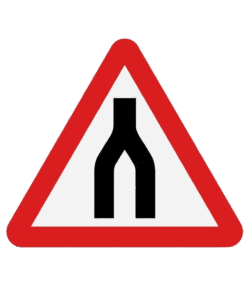
A red warning triangle showing two black lines that merge together into a single, narrow path.
Why Learners Fail
It looks almost identical to the standard sign for a road narrowing on both sides. Because of that, a lot of learners assume they just need to stay in the middle of their current lane, missing the fact that the two lanes are actually combining.
The Exact Meaning & Practical Reaction
This sign is telling you that the central barrier dividing the traffic is about to end, and the road is turning back into a standard two-way street.
If you happen to be overtaking a slower vehicle in the right-hand lane when you see this, you need to act quickly but safely. Either speed up to finish the pass or drop back so you can pull back over into the left lane before that central barrier completely disappears.

The Design
A red circle with two arrows inside—a big black one pointing forward in your direction, and a smaller red one pointing back towards you.
Why Learners Fail
Learners constantly confuse this with its exact opposite: the blue rectangular sign that has a big white arrow pointing forward and a small red arrow pointing back. Because they look so similar, it is easy to forget which one means you have to stop and which one means you have the right of way.
The Exact Meaning & Practical Reaction
Because this sign is a red circle, it is giving you a strict order. It means you do not have priority over oncoming traffic. You have to slow down or come to a full stop to let vehicles coming the other way pass through first. You will usually see this at narrow single-lane bridges or traffic-calming chicanes where the road gets too tight for two cars to pass.
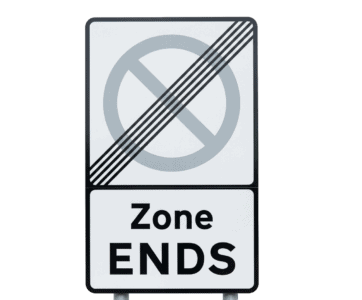
The Design
A white rectangle showing a faded grey “No Waiting” circle crossed out by five thin black diagonal lines. Just like in the image, it has a clear panel at the bottom that reads “Zone ENDS”.
Why Learners Fail
In the middle of a stressful test, it’s easy to mistake this for a National Speed Limit sign. The trap is that the speed limit sign is a circle with one thick black stripe, while this one uses five thin lines on a rectangle.
The Exact Meaning & Practical Reaction
This means you’re leaving a controlled zone where blanket parking restrictions applied without needing yellow lines.
It’s not a free pass to park anywhere, though. You’re just back to standard road rules, so keep an eye out for regular single or double yellow lines and make sure you aren’t blocking any junctions.

The Design
A solid red circle with a thick white horizontal bar running right through the middle of it.
Why Learners Fail
Even though everyone knows what this sign looks like in theory, it is actually one of the biggest reasons people instantly fail their driving test. Learners get so distracted looking for a turning or blindly listening to their sat-nav that they completely miss the sign and drive straight into a no-entry zone.
The Exact Meaning & Practical Reaction
This sign marks a point where you are completely forbidden to enter. If you pass it, you will be driving head-on into oncoming traffic on a one-way street.
If an examiner tells you to turn down a road with this sign, they are testing your observation skills. You have to ignore the instruction to turn, keep driving straight ahead safely, and look for the next safe route.

The Design
A blue rectangle split down the middle. On the left, two white arrows point up for standard traffic; on the right, a horizontal bus sits above an arrow pointing straight down.
Why Learners Fail
The busy layout with arrows pointing in completely opposite directions easily confuses people who aren’t used to driving through busy town centers.
The Exact Meaning & Practical Reaction
This sign warns you that a dedicated bus lane is running the opposite way to the regular flow of traffic on a one-way street.
When you pull out of a side road at a junction here, you have to look both ways with extra care. A lot of people make the mistake of only looking toward the standard flow of traffic, completely forgetting that a bus could be speeding toward them from the opposite direction.
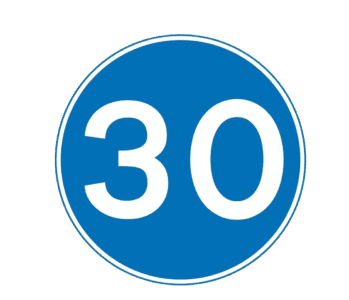
The Design
A solid blue circle with a white number, like 30, right in the middle.
Why Learners Fail
Just about every speed sign learners encounter is a red-bordered maximum limit. Because this one has a blue background, a lot of drivers mistakenly assume it is just an optional advisory speed or a recommendation for a specific lane, rather than a strict instruction.
The Exact Meaning & Practical Reaction
This sign sets a mandatory minimum speed limit. You are legally required to drive at or faster than the number on the sign, as long as it is safe to do so.
You usually see these inside major traffic tunnels or on incredibly busy roads. In these places, driving too slowly is dangerous because it creates a massive risk of a pile-up from vehicles crashing into you from behind.

The Design
A blue circle with two white arrows pointing diagonally downwards and outwards to both the left and right.
Why Learners Fail
It regularly gets confused with the simpler blue signs that have just one arrow telling you to “Keep Left” or “Keep Right” on pedestrian islands. Because it has two arrows instead of one, learners often freeze up trying to figure out which side they are actually supposed to take.
The Exact Meaning & Practical Reaction
You will see this sign at major splits in the road, traffic islands, or toll booths. It is letting you know that you can choose to pass on either the left or the right side of the obstacle ahead.
It does not matter which side you pick, because both lanes keep going forward and will take you to the exact same destination anyway.

The Design
A red warning triangle with a sharp, bold black exclamation mark right in the middle.
Why Learners Fail
A really common myth among learners is that this sign is only used to warn you about a hidden dip in the road ahead. Because of this rumor, people miss the fact that it is actually a general warning for other hazards that don’t have their own specific sign.
The Exact Meaning & Practical Reaction
This is a general hazard warning sign used for dangers that do not have their own unique symbol in the UK. The road signs state that this sign must almost always have a small text plate directly underneath it.
That plate will tell you exactly what the danger is—like “Blind summit,” “Quarry traffic,” or “Hidden dip.” As soon as you see it, you need to take your foot off the accelerator, slow down, and be ready to change your speed.

The Design
A standard red warning triangle with the clear silhouette of a toad right in the middle.
Why Learners Fail
Because you almost never see this sign in built-up urban or suburban test areas, a lot of learners think it is a joke. They often assume it is just an outdated sign that does not carry any real meaning for a modern driver.
The Exact Meaning & Practical Reaction
This is a real safety warning sign put up along seasonal migration routes where massive numbers of amphibians cross the road to get to their breeding ponds.
On damp, mild spring evenings, hundreds of migrating toads can completely cover the road surface. This creates a serious skidding hazard that can ruin your tires’ grip and double your total stopping distance. When you see this sign, slow down and drive with extra care.
Many new drivers struggle on their tests because they fall into these common traps:
Memorizing Instead of Understanding
Trying to memorize hundreds of separate signs is a one-way ticket to brain fry during a stressful exam. Instead, lean on the system we went over at the start of this guide. The moment you start using those basic shape and color rules to figure out signs on the move instead of just guessing, your test anxiety will completely disappear.
Ignoring the Rare Signs
It is easy to only focus on the signs you see every day during your practical driving lessons. But remember, the theory test loves to throw in the uncommon ones to see if you actually know your stuff.
Relying on Shortcuts
Skimming through random social media clips or unofficial apps isn’t enough. The Highway Code is the ultimate authority for road signs, and skipping a proper read-through always catches up with learners on test day.
Practice Daily (But Keep it Short)
You don’t need to pull all-night study sessions. Spending just 10 to 15 minutes every single day reviewing signs will build long-term memory much faster than cramming the night before.
Stick to Official Resources
We have focused on these 12 essential signs because they are the ones that catch people out the most. For a complete list, always stick to official Highway Code materials. Unofficial guides and online forums often use outdated graphics or incorrect descriptions that will only confuse you when test day comes.
Hammer the Mock Theory Tests
Don’t just read about signs—test yourself. Taking mock theory tests regularly is the best way to spot your weak areas before the real examiner does.
Look at the Shapes First
Train your eyes to recognize the shape and border color of a sign before you even look at the picture inside. This split-second habit gives you an instant head start on how to react.
Before you head down to the test center, it is a good idea to see how many of these signs you actually know under real exam conditions.
You can jump straight into our free car theory test practice exam, test your riding knowledge with our free motorbike theory mock test, or try your hand at the heavy vehicle questions on our HGV theory test practice free simulators to see if you are truly ready to pass on your first attempt.
Missing a sign on your theory test just costs you a single point. But messing up a sign during your practical driving test can cause an automatic failure and delay your independence. Treat your UK highway road signs revision with the exact same focus and dedication as your actual time behind the wheel.
Mastering UK road signs for learners is not just about ticking a box to pass a test because it is really about becoming a safe and confident driver for life. The everyday signs quickly become second nature, but it is the rare ones that usually trip learners up during both the theory exam and the practical driving test.
By taking the time to study these 12 commonly misunderstood road traffic signs in the UK, you are drastically boosting your road awareness, calm confidence, and chances of passing your theory test on your very first attempt.
We always encourage learners to look past basic memorization and actually understand the meaning behind every symbol. Investing a little extra time into learning the road signs today is the smartest way to protect yourself and your license the moment you get behind the wheel.
No account yet?
Create an Account