Get Free Consultation!
We are ready to answer right now! Sign up for a free consultation.
I consent to the processing of personal data and agree with the user agreement and privacy policy
Driving requires split-second choices. In fact, roughly 90% of your decisions behind the wheel come down to what you can see.
Think about the math: at 60 mph, your car covers 27 metres in just one second. If your eyesight is blurry or you have poor side vision, you could easily travel over 50 metres before your brain even realizes a car has slammed its brakes on in front of you.
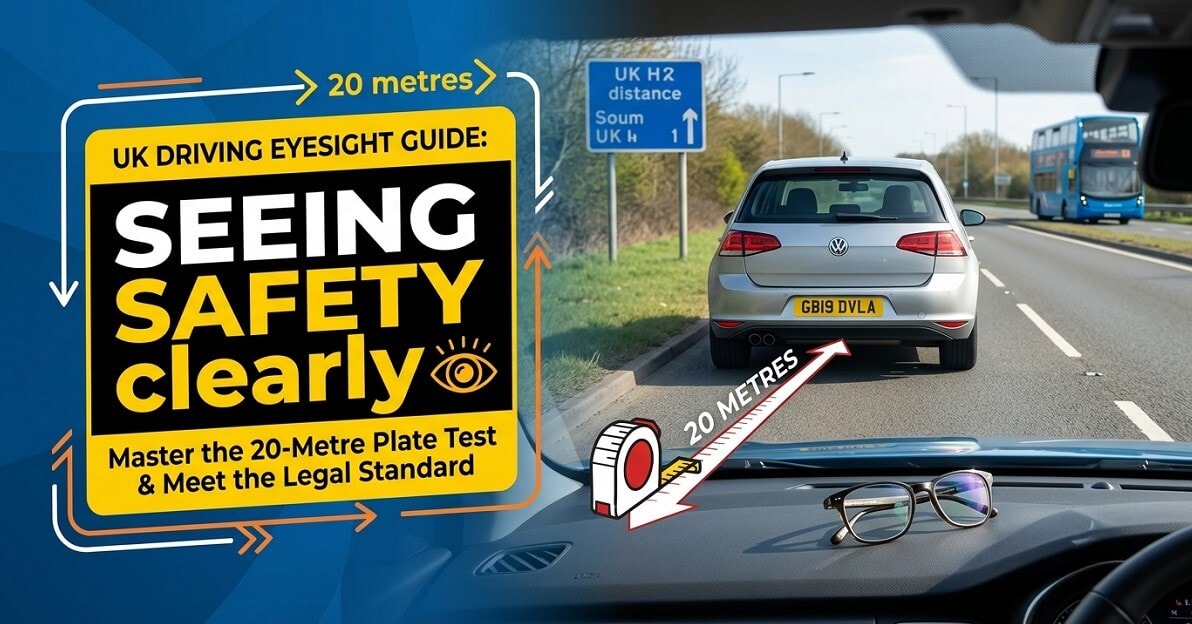
With road safety on the line, the DVLA enforces strict, non-negotiable eyesight laws to protect everyone on the road. To pass standard UK driving license eyesight checks and meet the legal baseline, you must be able to read a registration number plate clearly from a distance of 20 metres and achieve a visual acuity score of at least 6/12 (decimal 0.5) on a standard Snellen chart.
If you cannot meet this legal baseline, you cannot legally hold a driver’s licence in the UK for keeping the roads safe.
This guide covers standard legal baselines, but vision health varies. For definitive rules regarding your specific condition, check the official ‘Assessing fitness to drive‘ guidelines on GOV.UK or consult your optician.
To legally drive a car or ride a motorbike in the UK, your eyesight has to clear three strict tests:
While the legal limit is set in stone, picturing it on the road can be tough. When you’re practicing for your UK driving license eyesight checks, getting a feel for that target distance really helps.
Before you even touch the car keys or start the engine on your test day, your driving examiner will conduct a quick, mandatory vision check.
If you fail to read the third plate correctly, the test ends immediately. You will fail the practical test on the spot, lose your booking fee, and the DVLA will revoke your provisional licence straight away.
When you get tested in a clinic by an optician, hitting the official minimum eyesight for driving UK standard means matching the 6/12 baseline mentioned earlier.
They will check this using both of your eyes together. If you only have sight in one eye, they will just test your remaining functional eye.
On top of that, your side vision matters just as much. Your horizontal visual field needs to span at least 120 degrees, stretching out at least 50 degrees to both the left and the right so you can spot hazards easily.
You are completely fine to wear your glasses or contact lenses to meet the DVLA vision requirements for driving.
However, if you actually need them to pass that 20-metre mark, it becomes a strict legal rule to wear them every single time you get behind the wheel.
Driving without your prescription lenses is not just a minor mistake. It is a criminal offence under Section 96 of the Road Traffic Act, and doing it will instantly cancel out your car insurance policy too.
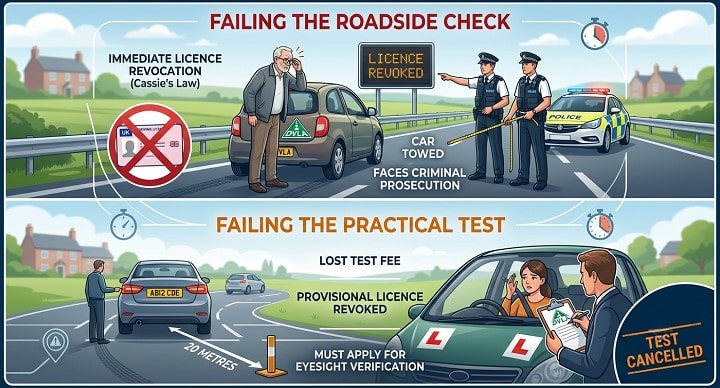
The penalty for failing an eyesight test for driving depends entirely on where you get caught out:
Standard car drivers and motorcyclists fall under the DVLA’s Group 1 rules. However, if you drive commercial HGVs, lorries, buses, or coaches, the stricter Group 2 rules apply instead. For these drivers, the DVLA sets mandatory eyesight standards that you must pass to legally operate them.
Professional drivers cannot simply self-declare their vision. You must pass an official medical examination during your initial application, every five years once you turn 45, and every single year after reaching age 65.
Here are the strict benchmarks a Group 2 driver must hit:
| Requirement | Standard to Pass |
|---|---|
| Better Eye Acuity | At least 6/7.5 (decimal 0.8) on a standard Snellen chart. |
| Worse Eye Acuity | At least 6/60 (decimal 0.1) on the chart. |
| Glasses Prescription Limit | If you wear glasses, the corrective power cannot exceed plus (+) 8 dioptres in any direction. (Note: There is no power limit if you wear contact lenses). |
| Horizontal Field of Vision | A minimum span of 160 degrees. |
| Peripheral Reach | Must extend at least 70 degrees left and right, and 30 degrees up and down. |
| Central Field Safety | Zero vision defects are allowed within the central 30-degree radius. |
While learner drivers get checked on their test day, qualified drivers are watched just as closely. The police regularly ramp up random roadside eyesight checks during local road safety campaigns.
Right now, drivers only have to self-declare that their vision is fine when they renew their licence at age 70.
However, the Department for Transport is actively looking at new proposals. They want to introduce mandatory, professional eye verification checks for older drivers every time they renew their licence.
Several progressive eye conditions can slowly ruin your sight without you even noticing. The most common issues that threaten your driving safety are:
You do not need to tell the DVLA about simple short-sightedness, long-sightedness, or colour blindness.
However, you are legally required to report any medical eye condition that affects both of your eyes. The same rule applies to your remaining functional eye if you only have sight in one.
If you are unsure whether your specific diagnosis must be declared, you can check if a health condition affects your driving on the GOV.UK portal.
Keeping a condition quiet is a serious risk. Failing to inform the DVLA about a medical eye condition that affects your driving carries a fine of up to £1,000, and you could face criminal prosecution if you end up in an accident.
If you state that you need glasses or contact lenses for driving, the DVLA will print “Code 01” on the back of your photocard licence. This makes it a legal offence to drive without wearing them.
You need to visit an optician to get your vision corrected with a new prescription. Once your sight meets the required standard, you must reapply to the DVLA using a D1 paper form. They will then arrange a mandatory eyesight verification test at a DVSA test centre before giving your licence back.
Only if your current vision is still safe and legal for driving. If you actually need your new prescription to see the road clearly, you should hold off on driving until your new glasses or contacts are ready.
Not at all! Being colour blind won’t stop you from holding a UK driving licence. When it comes to things like traffic lights, drivers are just expected to recognize the signals by where the lights are positioned and how bright they are, not just by the colour alone.
Absolutely. If the sun is glaring and it’s messing with your vision, you can definitely wear them. Just keep in mind that the examiner might ask you to take them off if the weather changes or if they need to chat with you during the test.
No, you aren’t legally required to carry any proof of an eye test or prescription with you. However, if your driving licence specifies that you need corrective lenses, the main rule is that you must actually be wearing them whenever you’re on the road.
Definitely. Things like an eye infection, blurry vision after a medical treatment, or even those dilating drops from an eye exam can really mess with your ability to drive safely. If your eyes aren’t 100% right, the best rule of thumb is to stay off the road until your vision gets completely back to normal.
Yes, they can. If an officer is concerned that you might not be able to see clearly enough to drive safely, they are allowed to ask you to read a car number plate from a specific distance. If you can’t do it, they may report it to the DVLA, which could lead to your driving licence being reviewed.
Passing an eye vision test for driving in the UK isn’t just a legal chore. It is a vital safety check that keeps everyone on the road safe.
Because your eyesight drops so gradually over time, it is almost impossible to judge your own vision accurately.
Getting regular check-ups with a professional optician is the only reliable way to safeguard your licence, protect yourself from heavy fines, and make sure you are completely safe behind the wheel.
If you have cleared your eye checks and are ready to get back behind the wheel, don’t let massive test backlogs delay your freedom. Sharpen your road knowledge using our free online car theory test practice, and let us help you secure a fast-track practical test appointment at Fast UK Licensed today!

No account yet?
Create an Account