Get Free Consultation!
We are ready to answer right now! Sign up for a free consultation.
I consent to the processing of personal data and agree with the user agreement and privacy policy
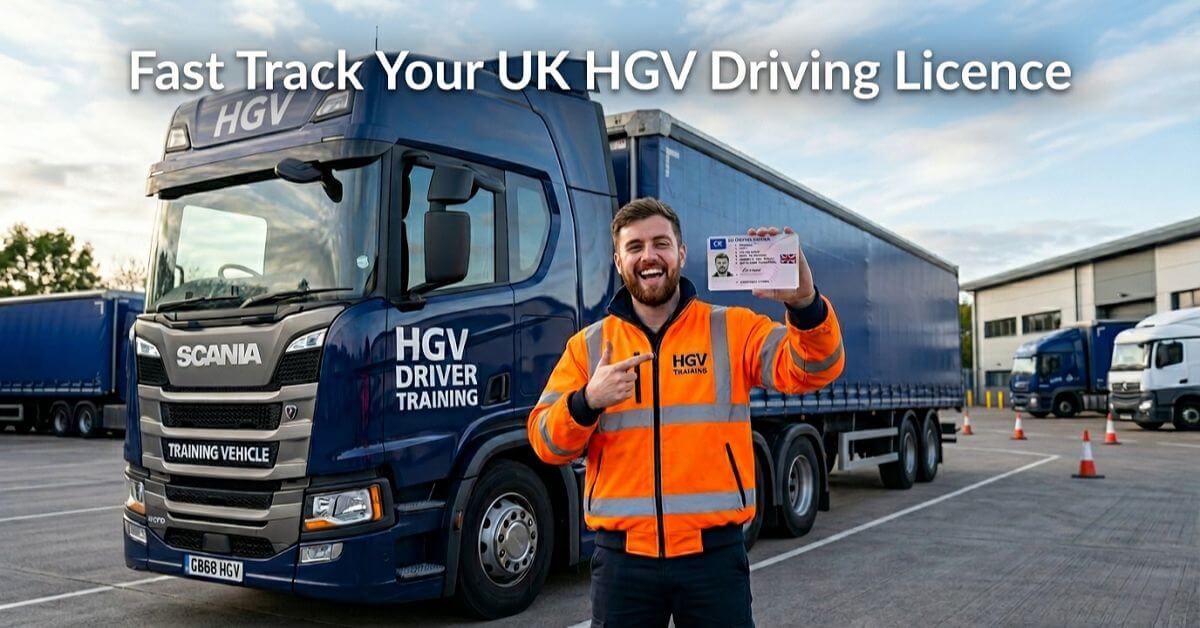
Demand for qualified commercial drivers across the UK is through the roof right now, which makes getting your commercial entitlements a massive career win. That said, if you are searching for how to get HGV licence UK training started, the usual paperwork maze can feel completely overwhelming.
This fast-track guide cuts straight through the red tape, showing you exactly how to skip the admin headaches and get behind the wheel as fast as possible.
Before you even think about looking at training schools or booking exams, you need to clear a few basic legal hurdles set by the DVLA and DVSA.
The core HGV licence requirements UK state that you must hold a full, valid UK Category B car driving licence before you can apply for any commercial entitlements. If you are starting from scratch, you can read our step-by-step guide on how to get full driving licence requirements here.
Think of your car licence as proof that you already know the basic rules of the road and have actual driving experience. On top of that, you just need to be at least 18 years old to kickstart your training.
A lot of career changers assume the transport industry only wants younger drivers, but that is a total myth.
In reality, there is absolutely no maximum age limit to get an HGV licence in the UK. Whether you are 21, 45, or 65, you have the exact same legal right to train, pass your test, and land a job as a commercial driver.
The only thing that actually changes as you get older is how often you have to get a medical checkup:
To get your UK HGV licence without wasting time you have to follow the exact legal steps. Missing one form or booking things out of order can delay your application for weeks.
Commercial drivers are held to very strict health standards. You need to book an appointment with a GP or a specialized private driver medical provider to complete a D4 Medical Examination Report. The doctor will check your vision, blood pressure, and general health to ensure you are completely fit to operate heavy vehicles.
Once you have your passed D4 form you need to order and fill out the D2 Application Form from the DVLA. Send your physical photocard car licence along with the D2 form and the D4 medical report directly to the DVLA. They will update your record to grant you provisional entitlements for Category C rigid trucks or Category C+E articulated trucks.
As soon as your licence drops back through the letterbox from the DVLA, you’re legally clear to get your theory exams booked. The HGV theory test comes in two parts: multiple-choice and hazard perception clips. You have to pass both before you can book your practical driving course, so it definitely pays to get a head start on your revision.
If you plan to earn money as an HGV driver you must hold a Certificate of Professional Competence. This requires passing the CPC Part 2 case studies test which is a computer based exam that evaluates real world driving scenarios.
Book an intensive 5 to 7 day practical HGV driving course. Once your training is complete you will take your practical tests to prove you can safely load, secure, and operate the vehicle.

The quickest way to waste time and stall your progress is training for the wrong vehicle. It used to be that you had to pass your Category C (rigid truck) test first before you were even allowed to look at a Category C+E (articulated lorry).
Thankfully, the UK rules changed. You can now jump straight from your standard car licence right into a Category C+E, skipping the middle step entirely.
| Licence Category | What You Can Drive | Max Weight | Best For |
|---|---|---|---|
| Category C (Class 2 / Rigid) | Regular trucks where the cab and cargo bed are all one piece. Think bin lorries, fire engines, and local supermarket delivery trucks. | Anything over 3.5 tonnes (with no upper limit as long as it’s a rigid frame). | Multi-drop local deliveries, town driving, and domestic trade work. |
| Category C+E (Class 1 / Artic) | The big rigs. Tractor units pulling separate trailers, massive containers, and tippers where the cab detaches. | Up to 44 tonnes. | Long-distance driving, overnight trunking runs, and making the absolute top money. |
The total cost of getting your HGV licence in the UK depends entirely on the path you choose. If you go for a full, all-inclusive intensive course with a proper training school, you’re looking at anywhere from £1,500 to £3,500.
That price covers your driver’s medical, all your revision materials, the actual DVSA test fees, and about a week of intensive, one-on-one time in the cab with an instructor.
Here is how the mandatory government fees break down individually. Keep in mind, if you’re planning to drive for a living, your total will include the extra Driver CPC modules (Modules 2 and 4) required to go pro:
| Test Module | Required For | Standard DVSA Cost |
|---|---|---|
| D4 Medical Exam | All initial applicants | £50 – £120 (Provider dependent) |
| Theory Part 1a (Multiple Choice) | Core licence requirement | £26 |
| Theory Part 1b (Hazard Perception) | Core licence requirement | £11 |
| Driver CPC Module 2 (Case Studies) | Professional, paid drivers | £23 |
| Practical Module 3a (Off-Road Exercises) | Core licence requirement | £40 |
| Practical Module 3b (On-Road Driving) | Core licence requirement | £115 (Weekdays) / £141 (Weekends) |
| Driver CPC Module 4 (Practical Demo) | Professional, paid drivers | £55 |
Once you step up to Class 1 and get a bit of experience under your belt, hitting over £50,000 a year is completely standard—especially if you pull long-haul container loads or handle specialized hazardous cargo.
From day one until your new licence arrives, getting an HGV licence in the UK takes between 8 and 12 weeks, as long as you keep things moving.
The best way to stick to this timeline is to use an online practice platform to smash your theory revision while the DVLA down in Swansea is sorting out your provisional paperwork. If you just sit around doing nothing for three weeks waiting for your licence to drop through the letterbox before you even open a book, you’re basically adding a month of completely dead time to your calendar.
Once your provisional licence arrives, you can book and sit your theory tests right away. As soon as you pass those, you can jump straight into a 5-to-7 day intensive driving course.
It means the actual time you spend behind the wheel learning to handle the truck is incredibly short. Most of the timeline is just waiting around for the DVLA to process your paperwork and waiting for a DVSA test slot to open up.
Renewing the actual HGV entitlement on your licence with the DVLA costs absolutely nothing (£0). The government doesn’t charge an administrative fee for the five-year renewal cycle.
You just need to fill out the standard postal renewal forms to keep your categories active. However, while the paperwork itself is free, keeping your licence fully legal and compliant does bring a couple of regular maintenance costs:
The HGV theory test is a completely different beast compared to the standard car exam—it’s much longer and a lot more technical. Plus, with test center waiting lists backed up for weeks, failing isn’t just frustrating; it completely derails your plans of getting on the road quickly.
The test is strictly broken down into two distinct modules:
Standard driving theory test practice is great for memorizing road signs, but a full mock driving theory test is a realistic dress rehearsal with a ticking clock and a strict passing score.
To make sure you aren’t caught off guard by how these truck exams work, your best bet is to use a proper practice layout. Running through mock tests under realistic exam conditions is the only real way to get comfortable and shake off any nerves before the big day.
Passing your practical test gets you the licence, but the Driver CPC is what actually gives you the legal right to earn a living with it. If you’re driving an HGV for any kind of business or profit, you absolutely must carry your CPC card on you.
If you’re a brand-new driver, you’ll complete your Initial CPC at the same time as your main training using a step-by-step modular system:
The biggest bottleneck in getting your HGV licence quickly is almost always waiting for an open DVSA test slot. Backlogs at local test centres can cause massive delays if you try to book everything yourself.
Using a managed booking service means someone is actively watching the DVSA system to snap up short-notice cancellations and lock in an early date for you. By timing your intensive practical week perfectly with your test date, you can shave weeks off the wait and get out of your car and into a high-earning truck cab much faster.
No account yet?
Create an Account